
Resources
Studies, reports, books and guides to help you make sense of the Sunday Blues
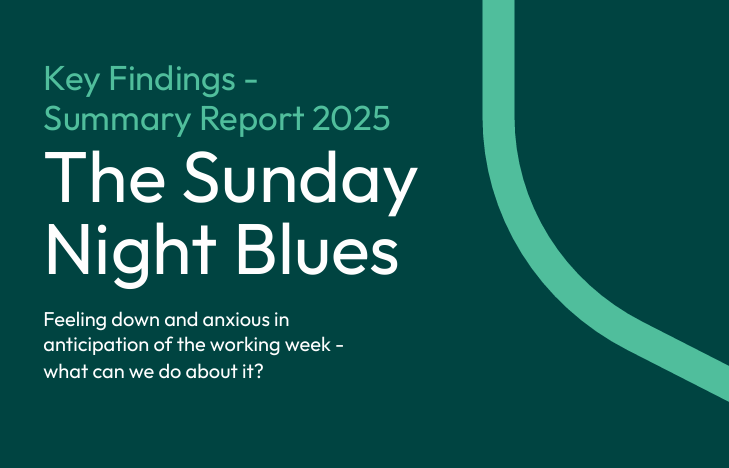
The Sunday Night Blues: Key findings
Our summary report with initial findings. How many people get the Sunday blues? How does it feel? What can we do about it?
Every Mind Matters
This report was released in 2022 by the UK Department of Health & Social Care, and finds that 7 in 10 Brits regularly experience the Sunday Night Blues.

Why does it matter?
AXA Mind Health Study 2024: New research shows poor mind health in the workplace costs the UK economy £102bn a year.
CIPD factsheets (2026). Employee turnover and retention: https://www.cipd.org/uk/knowledge/factsheets/turnover-retention-factsheet/
Academic studies
- Binnewies C., Sonnentag S., Mojza E. J. (2010). Recovery during the weekend and fluctuations in weekly job performance: A four-week longitudinal study examining intra-individual relationships. Journal of Occupational and Organisational Psychology, 83, 419–441. View study
- Sonnentag, S. (2012). Psychological detachment from work during leisure time: The benefits of mentally disengaging from work. Current Directions in Psychological Science, 21(2), 114–118. View study
- Sonnentag, S. (2018). The recovery paradox: Portraying the complex interplay between job stressors, lack of recovery, and poor well-being. Research in Organizational Behavior, 38, 169-185. View study
- Weigelt, O., Siestrup, K., & Prem, R. (2021). Continuity in transition: Combining recovery and day‐of‐week perspectives to understand changes in employee energy across the 7‐day week. Journal of Organizational Behavior, 42(5), 567-586. View study
Mental health resources
- NHS Every Mind Matters campaign
Practical, bite-sized wellbeing advice (stress, anxiety, low mood, sleep), plus a short “Mind Plan” quiz that suggests personalised next steps and optional email support
- NHS mental health resources
The NHS’s main mental health hub: symptoms and conditions, self-help tools, treatment options (including talking therapies), service signposting, and how to get urgent help. - Mind: The mental health charity
Clear information and guidance if you’re struggling or supporting someone else, including “how I’m feeling right now”, mental health A–Z, local support, and helplines. - Samaritans: Together, we save lives
24/7 confidential listening support if someone is in crisis or needs to talk, with straightforward ways to get in touch (including calling 116 123 in the UK)

How to manage the Sunday Blues
Make your meetings more efficient and enjoyable – book by Steven Rogelberg: The Surprising Science of Meetings
Academic studies
- Rook, J. W., & Zijlstra, F. R. H. (2006). The contribution of various types of activities to recovery. European Journal of Work and Organizational Psychology, 15(2), 218–240. View study
- Gabriel, K. P., & Aguinis, H. (2022). How to prevent and combat employee burnout and create healthier workplaces during crises and beyond. Business Horizons, 65(2), 183–192. View study
- Chiu, C. Y., Howard, M., Lopes, E., Kulik, C. T., & Tuckey, M. R. (2024). Put your own “oxygen mask” on first: A behavioral typology of leaders’ self-care. Human Resource Management, 63(2), 243–263. View study

Other academic research relevant to work-related well-being and the Sunday Blues
- Akay, A., & Martinsson, P. (2009). Sundays are Blue: Aren’t They? The Day-of-The-Week Effect on Subjective Well-Being and Socio-Economic Status. In Discussion Paper, Institute for the Study of Labor (Issue No 4563). View study
- Inceoglu, I., Arnold, K. A., Leroy, H., Lang, J. W., & Stephan, U. (2021). From microscopic to macroscopic perspectives and back: The study of leadership and health/well-being. Journal of Occupational Health Psychology, 26(6), 459. (Open Access). View study
- Inceoglu, I., Thomas, G., Chu, C., Plans, D., & Gerbasi, A. (2018). Leadership behavior and employee well-being: An integrated review and a future research agenda. The Leadership Quarterly, 29(1), 179–202. View study
- Ryan, R. M., Bernstein, J. H., & Brown, K. W. (2010). Weekends, work, and well-being: Psychological need satisfactions and day of the week effects on mood, vitality, and physical symptoms. Journal of Social and Clinical Psychology, 29(1), 95–122. View study
- Stone, A. A., Schneider, S., & Harter, J. K. (2012). Day-of-week mood patterns in the United States: On the existence of ‘Blue Monday’, ‘Thank God it’s Friday’ and weekend effects. The Journal of Positive Psychology, 7(4), 306–314. View study
- Weigelt, O., Gierer, P., Prem, R., Fellmann, M., Lambusch, F., Siestrup, K., … & Blume, J. (2022). Time to recharge batteries – development and validation of a pictorial scale of human energy. European Journal of Work and Organizational Psychology, 31(5), 781–798. View study
- Weigelt, O., Siestrup, K., & Prem, R. (2021). Continuity in transition: Combining recovery and day-of-week perspectives to understand changes in employee energy across the 7-day week. Journal of Organizational Behavior, 42(5), 567–586. View study